

Starting date: May 2022
Work Programme
The overall objective of the Gastric Cancer Prevention Team (GCP) is to contribute to the reduction of the global burden of gastric cancer. To fulfil this objective, GCP aims to produce robust evidence to improve the understanding of the causes of gastric cancer; evaluate the effectiveness of population-based interventions and prevention programmes; and, ultimately, implement evidence-based interventions for the prevention and control of gastric cancer. GCP seeks to achieve these aims through cross-Agency and international collaborations.
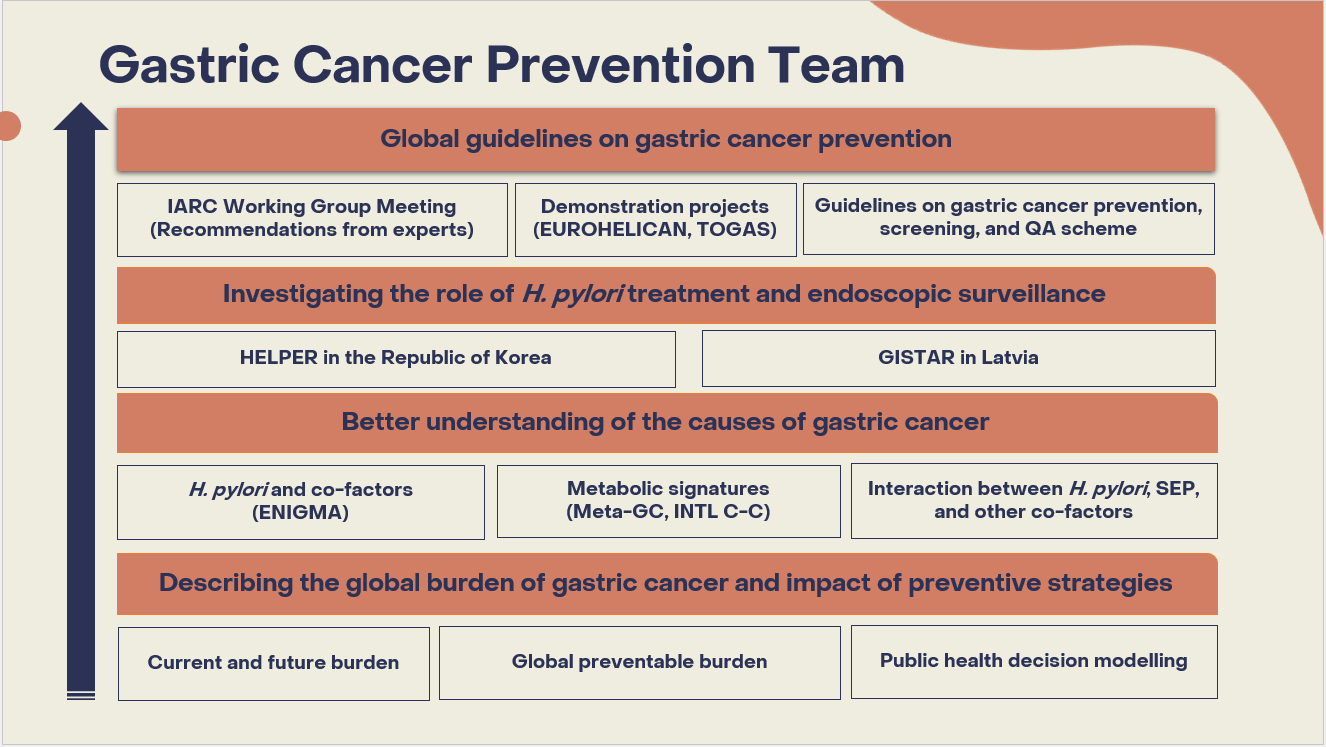
GCP has four main themes and related activities:
- Describing the current and future burden of gastric cancer
- Understanding the global burden of gastric cancer attributable to Helicobacter pylori infection, its preventable fraction, and costs related to prevention strategies
- Estimating the expected burden of H. pylori-related diseases, focusing on gastric cancer and peptic ulcer diseases in high-risk areas
- Estimating the impact of various H. pylori screen-and-treat scenarios on gastric cancer burden through public health decision modelling
- Understanding risk factors in diverse populations with variable gastric cancer risks using standardized multicentre protocols by conducting the following studies:
- International prevalence surveys of Helicobacter pylori in high- and low-risk areas for stomach cancer – Epidemiological Investigation of Gastric Malignancies (ENIGMA) studies
- Exploring metabolic disturbances associated with gastric cancer development in European populations (Meta-GC) – European Prospective Investigation into Cancer and Nutrition (EPIC) collaboration
- Circulating metabolites as novel risk biomarkers for gastric cancer: a large multicentre prospective investigation – International Gastric Cancer Cohort Consortium (INTL-CC)
- Investigating the role of H. pylori treatment and endoscopic screening for gastric cancer prevention in high-incidence areas by co-leading clinical trials:
- Effect of H. pylori eradication on gastric cancer prevention in the Republic of Korea: a randomized controlled clinical trial (HELPER, collaboration with the National Cancer Center of the Republic of Korea)
- Multicentre randomized study of H. pylori eradication and pepsinogen testing for prevention of gastric cancer mortality (GISTAR, collaboration with the University of Latvia)
- Conducting implementation research focusing on population-based H. pylori screen-and-treat strategies in high-risk populations for the prevention and reduction of inequalities caused by gastric cancer
- Towards Gastric Cancer Screening Implementation in the European Union (TOGAS)
- Advancing gastric cancer screening implementation in Europe (TOGAS Plus)
- Developing global guidelines for gastric cancer prevention by leading the following major projects:
- Population-based H. pylori screen-and-treat strategies for gastric cancer prevention – guidance on implementation (IARC Working Group Report No. 12)
- European guidelines on gastric cancer prevention, screening, and care and the quality assurance schemes (European Commission Initiative on Gastric Cancer) in collaboration with the European Commission’s Joint Research Centre
The global burden of gastric cancer is expected to increase substantially due to demographic shifts (PMID:40624406), and this cancer type contributes considerably to cancer disparities in many world regions; therefore, more research into gastric cancer etiology and prevention is warranted. GCP’s wide range of activities – including etiological research projects identifying novel biomarkers, randomized controlled clinical trials of primary and secondary prevention, and implementation projects of H. pylori screen-and-treat programmes – provide a comprehensive overview of gastric cancer prevention efforts from IARC and offer further opportunities for new collaborations.
Team Composition
Team Leader: Dr Jin Young Park, Early Detection, Prevention, and Infections Branch (EPR), IARC
Email: parkjy@iarc.who.int
Team members:
Ms Viktoria Knaze (Project Officer, EPR)
Dr Naila Aba (Postdoctoral Scientist, EPR)
Dr Taylor James Cromarty (Postdoctoral Scientist, EPR)
Dr Oliver Langselius (Postdoctoral Scientist, EPR)
Ms Julie Chupin (Project Assistant, EPR)
Dr Partha Basu (Branch Head, EPR)
Dr Gary Clifford (Deputy Branch Head, EPR)
Dr Iacopo Baussano (Scientist, EPR)
Dr Andrea Gini (Scientist, EPR)
Dr Mazda Jenab (Deputy Branch Head, NME)
Dr Pekka Keski-Rahkonen (Scientist, NME)
Dr Sabina Rinaldi (Deputy Branch Head, NME)
Dr Béatrice Lauby-Secretan (Deputy Branch Head, ESC)
Dr Daniela Mariosa (Scientist, ESC)
Dr Florence Le Calvez-Kelm (Scientist, GEM)
Ms Nathalie Forey (Research Assistant, GEM)
Dr Behnoush Abedi-Ardekani (Scientist, GEM)
Dr Isabelle Soerjomataram (Deputy Branch Head, CSU)
Dr Eileen Morgan (Scientist, CSU)
Contact: gcp@iarc.who.int
Key networks: The international team members span many countries, including networks from HELPER (the Republic of Korea), ENIGMA (Chile, the Islamic Republic of Iran, Uganda, Zambia, New Zealand, Mongolia, and Egypt), GISTAR (Latvia), EUROHELICAN (Slovenia, Latvia, and France), TOGAS (Latvia, Austria, Belgium, Croatia, France, Germany, Ireland, Lithuania, the Netherlands, Poland, Portugal, Romania, Slovenia, and Spain), EPIC (France, Italy, Spain, the United Kingdom, the Netherlands, and Germany), and INTL-CC (USA).
Key funding: French National Cancer Institute (INCa), EU4Health (European Union), United States National Institutes of Health (NIH)
Key publications
- Park JY, Lee YC, Moayyedi P, Lansdorp-Vogelaar I, Camargo MC, Tepeš B, et al. (2026). Helicobacter pylori screen-and-treat programs for gastric cancer prevention – IARC Working Group Report. N Engl J Med. 394(11):1131–7. https://doi.org/10.1056/NEJMsb2515372 PMID:41812202
- Hoang T, Keski-Rahkonen P, Jenab M, Knaze V, Shin A, Park JY (2026). Systematic review of current evidence on metabolites associated with gastric cancer. J Natl Cancer Inst. djag053. https://doi.org/10.1093/jnci/djag053 PMID:41706114
- Park JY, Georges D, Alberts CJ, Bray F, Clifford G, Baussano I (2025). Global lifetime estimates of expected and preventable gastric cancers across 185 countries. Nat Med. 31(9):3020–7. https://doi.org/10.1038/s41591-025-03793-6 PMID:40624406
- Ford AC, Yuan Y, Park JY, Forman D, Moayyedi P (2025). Eradication therapy to prevent gastric cancer in Helicobacter pylori-positive individuals: systematic review and meta-analysis of randomized controlled trials and observational studies. Gastroenterology. 169(2):261–76. https://doi.org/10.1053/j.gastro.2024.12.033 PMID:39824392
- Rumgay H, Georges D, Huang Y, Hirabayashi M, Shah R, de Martel C, et al. (2026). Global burden of cancer attributable to infections in 2024: a worldwide incidence analysis. Lancet Oncol. (Forthcoming)
- Alberts C, Georges D, Franceschi S, Baussano I, Park JY, Rumgay H, et al. (2026). Oncogenic infections: targets highly amenable to cancer prevention. J Natl Cancer Inst Monogr. 2026(72):59–68. https://doi.org/10.1093/jncimonographs/lgaf040 PMID:42008731
- Rugge M, Genta RM, Malfertheiner P, Dinis-Ribeiro M, El-Serag H, Graham DY, et al.; RE.GA.IN (2024). RE.GA.IN.: the Real-world Gastritis Initiative – updating the updates. Gut. 73(3):407–41. https://doi.org/10.1136/gutjnl-2023-331164 PMID:38383142
- Sun D, Mülder DT, Li Y, Nieboer D, Park JY, Suh M, et al. (2024). The effect of nationwide organized cancer screening programs on gastric cancer mortality: a synthetic control study. Gastroenterology. 166(3):503–14. https://doi.org/10.1053/j.gastro.2023.11.286 PMID:38007053
- Park JY, Choi IJ (2026). Advancing gastric cancer prevention in Korea: current strategies and future directions. Helicobacter. 31(2):e70121. https://doi.org/10.1111/hel.70121 PMID:41947374
- Leja M, Ražuka-Ebela D, Tepes B, Bornschein J, Ribeiro MD, Budnik TM, et al.; TOGAS Study Group (2026). Overview of gastric cancer prevention initiatives in Europe. Helicobacter. 31(2):e70126. https://doi.org/10.1111/hel.70126 PMID:41981861