IARC Monographs Programme Home
The IARC Monographs Programme is a key initiative of the International Agency for Research on Cancer (IARC). The Monographs Programme evaluates the carcinogenic hazard to humans of various agents, including occupational and environmental exposures, complex exposures (e.g. air pollution), and chemical and biological agents (e.g. certain pesticides or viruses). IARC does not make recommendations or undertake risk assessments related to the agents identified as carcinogenic by the Monographs Programme. However, its classifications are used by health authorities worldwide, including the World Health Organization (WHO) and governments, to implement effective public health policies aimed at preventing cancer.
The IARC Monographs Programme identifies agents that can cause cancer in humans at least in some scenarios or at some exposure levels and routes. That is, the Monographs assess carcinogenic hazards. The Monographs are not a risk assessment exercise, but cancer hazard identification is often the first step in a risk assessment process that may be carried out by WHO or governmental health agencies. Monographs evaluations play a critical role in raising awareness of hazardous exposures and can flag the need for risk assessments, which are then often conducted by health authorities worldwide, including WHO, to protect their populations. IARC collaborates closely with WHO to ensure that hazard identification and risk assessment are coordinated and communicated appropriately.
In this unique programme, independent international experts, who are free from conflicts of interest, provide a rigorous and systematic review and integration of scientific evidence from all research that is in the public domain in its final form. The methodologies used by the Monographs Programme are documented in a Preamble by an Advisory Group of experts in cancer research and public health and have formed a model that has been adopted by other organizations conducting hazard evaluation around the world. The Preamble to the IARC Monographs describes the objective and scope of the programme, the scientific principles and procedures used in developing a Monographs volume, the types of evidence considered, and the scientific criteria that guide the evaluations.
The IARC Monographs Programme has had significant positive impacts in many major areas, including:
- providing evidence on exposure to second-hand tobacco smoke (also called environmental tobacco smoke) and lung cancer, which has led to smoking bans in indoor public places in more than 130 countries;
- identifying asbestos as a carcinogen, resulting in widespread bans and regulations;
- evaluating perfluorooctanoic acid (PFOA) as a carcinogen and providing key evidence to governments and regulatory authorities; and
- evaluating occupational exposure as a firefighter as carcinogenic, prompting improved safety measures and regulations to protect firefighters.
Questions and answers
Highlighted questions and answers
How is an IARC Monographs Programme evaluation carried out?
A Working Group of independent international experts carries out the evaluation. The independent experts assemble and critically review the scientific evidence according to strict criteria. These criteria focus on determining the strength of the available evidence that the agent causes cancer, as described in the Preamble to the IARC Monographs, which is available here.
The experts review the data available globally on situations in which people are exposed to the agent. They also critically review three different types of data:
- Epidemiological studies on cancer in humans exposed to the agent (scientific evidence of carcinogenicity in humans)
- Experimental studies on cancer in laboratory animals treated with the agent (scientific evidence of carcinogenicity in experimental animals)
- Studies on whether the agent has any of the recognized key characteristics of human carcinogens (scientific evidence on carcinogen mechanisms).
During the in-person meeting in Lyon, France, the Working Group finalizes the scientific review and evaluation of these three streams of evidence. The Working Group also combines its conclusions into a consensus overall evaluation of the strength of the evidence of the carcinogenicity of the agent to humans. The Working Group classifies the agent into one of four categories.
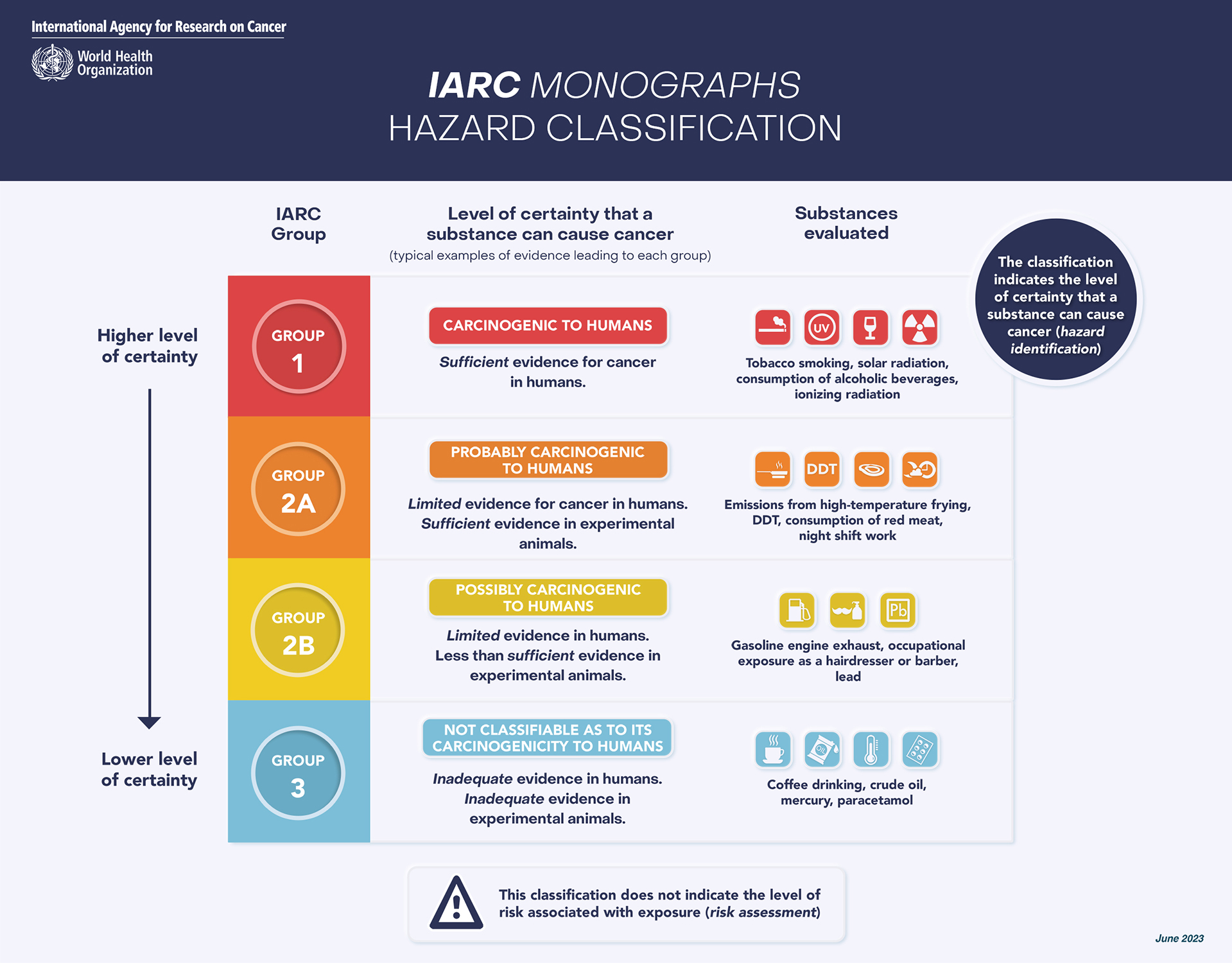
What are the Monographs classification categories?
The Working Group classifies an agent into one of four categories, ranging from carcinogenic to humans (Group 1) to not classifiable as to its carcinogenicity to humans (Group 3). The categories of the classification indicate the strength of the evidence as to whether an agent is capable of causing cancer (technically called “hazard”), but it does not measure the likelihood that cancer will occur (technically called “risk”) at a particular level of exposure to the agent.
What does the Monographs classification mean in terms of risk?
The classification indicates the strength of the evidence that a substance or agent can cause cancer. The IARC Monographs Programme seeks to identify agents that are cancer hazards, meaning they pose the potential for the exposure to cause cancer. However, the classification does not indicate the level of risk associated with a given level or circumstance of exposure. The cancer risk associated with substances or agents assigned the same classification may be very different, depending on factors such as the type and extent of exposure and the size of the causal effect of the agent at a given level of exposure.
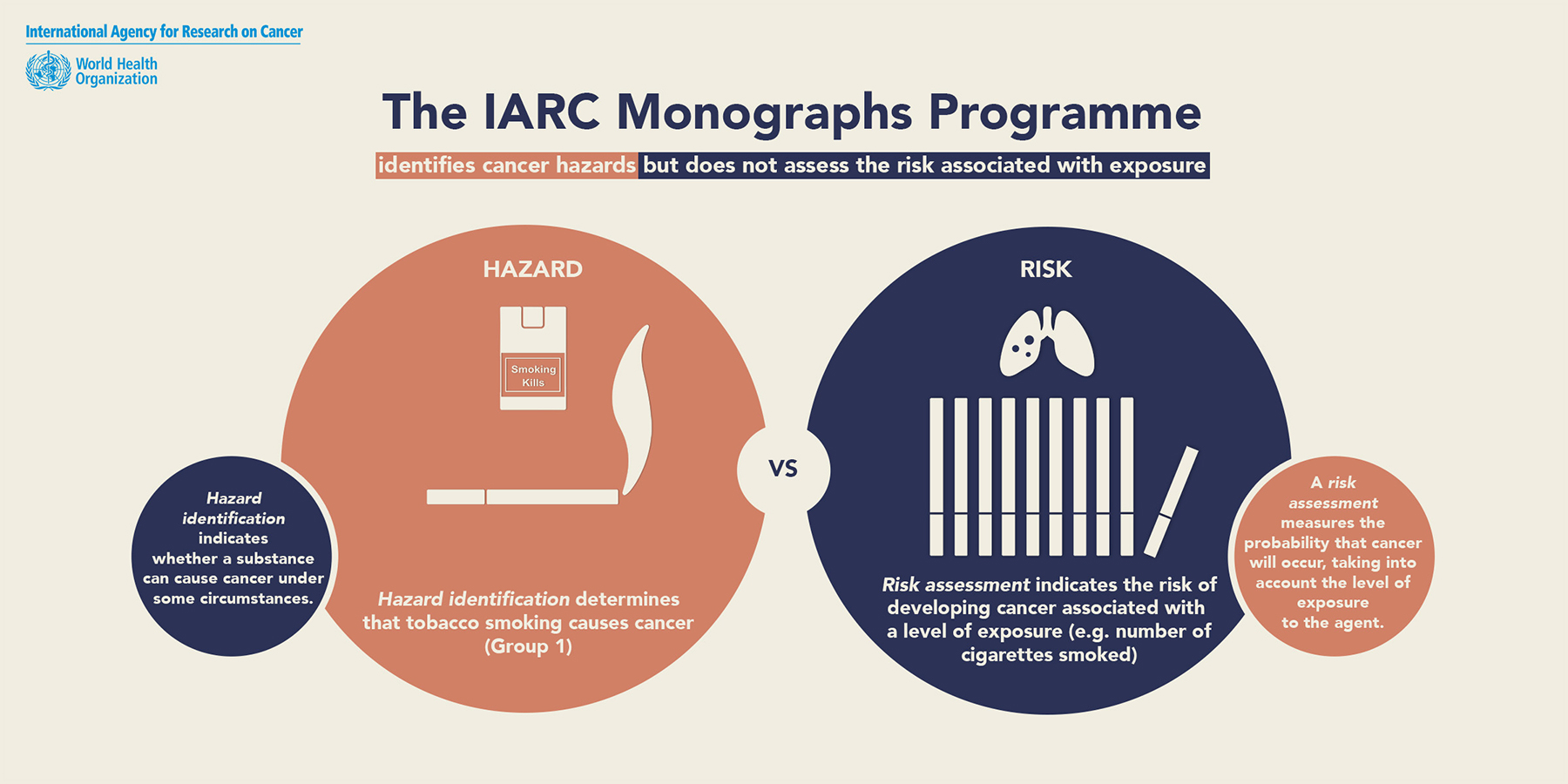
What is the difference between risk and hazard?
The IARC Monographs Programme identifies cancer hazards but does not evaluate the risks associated with specific levels or circumstances of exposure. The distinction between hazard and risk is important. An agent is considered a cancer hazard if it is capable of causing cancer under at least some circumstances and levels of exposure. Risk characterization measures the probability that cancer will occur, taking into account the level of exposure to the agent and the size of the causal effect on that cancer per unit of exposure. The IARC Monographs Programme may identify cancer hazards even when risks are very low with known patterns of use or exposure. Recognition of such carcinogenic hazards is important because new uses or unforeseen exposures could lead to risks that are much higher than those currently seen. For most of the agents recently classified in Group 1 by the IARC Monographs Programme, levels shown to cause cancer were observed in people exposed to relevant levels in the workplace and the environment (see Schubauer-Berigan et al., 2026).
Why should two substances or agents classified in the same Group not be compared?
The Monographs classifications reflect the strength of the scientific evidence as to whether an agent can cause cancer in humans, but they do not reflect how high the risk of developing cancer is at a given exposure level. The types of exposures, the extent of risk, the people who may be at risk, and the cancer types linked with the agent can be very different across agents. Therefore, comparisons within a category can be misleading.
First, exposures may vary widely. For example, there is widespread exposure to the Group 1 agent air pollution, whereas far fewer people would be exposed to certain Group 1 chemicals, such as 1,2-dichloropropane. Second, the magnitude of risk associated with exposure to two agents may be very different. Active smoking carries a much higher risk of lung cancer than do second-hand smoke or air pollution, although all three are classified in Group 1. Third, the number of resulting cancers can be different; for example, tobacco smoking causes some common cancer types, whereas 1,2-dichloropropane causes a rare cancer of the bile duct. This also applies to Group 2 agents. For example, radiofrequency electromagnetic fields and the prescription drug digoxin are both classified in Group 2B.
In summary, because the Groups indicate the strength of the evidence regarding a cancer hazard and not the cancer risk at a given level of exposure, the cancer risk associated with two agents classified in the same Group may be very different.
Why is hazard identification important?
Hazard identification is the first fundamental step of risk assessment, which is necessary to set exposure limits in the workplace and the environment. Many national and international health authorities make decisions about public health actions to prevent cancer on the basis of hazard identifications conducted by the IARC Monographs Programme. As another example, hazard classifications also provide a useful warning to first responders about chemical agents they may encounter in the course of their emergency response work.
What is the relationship between IARC and WHO?
IARC is the specialized cancer research agency of WHO, established in May 1965 by a resolution of the World Health Assembly. IARC is governed by its Governing Council and Scientific Council; the former comprises representatives from each IARC Participating State, plus the WHO Director-General. IARC has its own defined scientific methods as set by the Preamble to the IARC Monographs. More information about IARC governance can be found here. IARC has a unique dual position as an independent international cancer research institute and as the specialized cancer research agency of WHO within the United Nations system.
Questions and answers about the IARC Monographs are available at
IARC Monographs Q&A (PDF)