IARC/WHO Values
All IARC/WHO personnel have a responsibility to maintain and demonstrate the highest ethical and professional conduct while contributing to the mission and vision of the Agency.
As a specialized agency within the United Nations system, IARC/WHO is firmly committed to the ethical principles of integrity, professionalism, respect for diversity, human rights, universality, and equity.
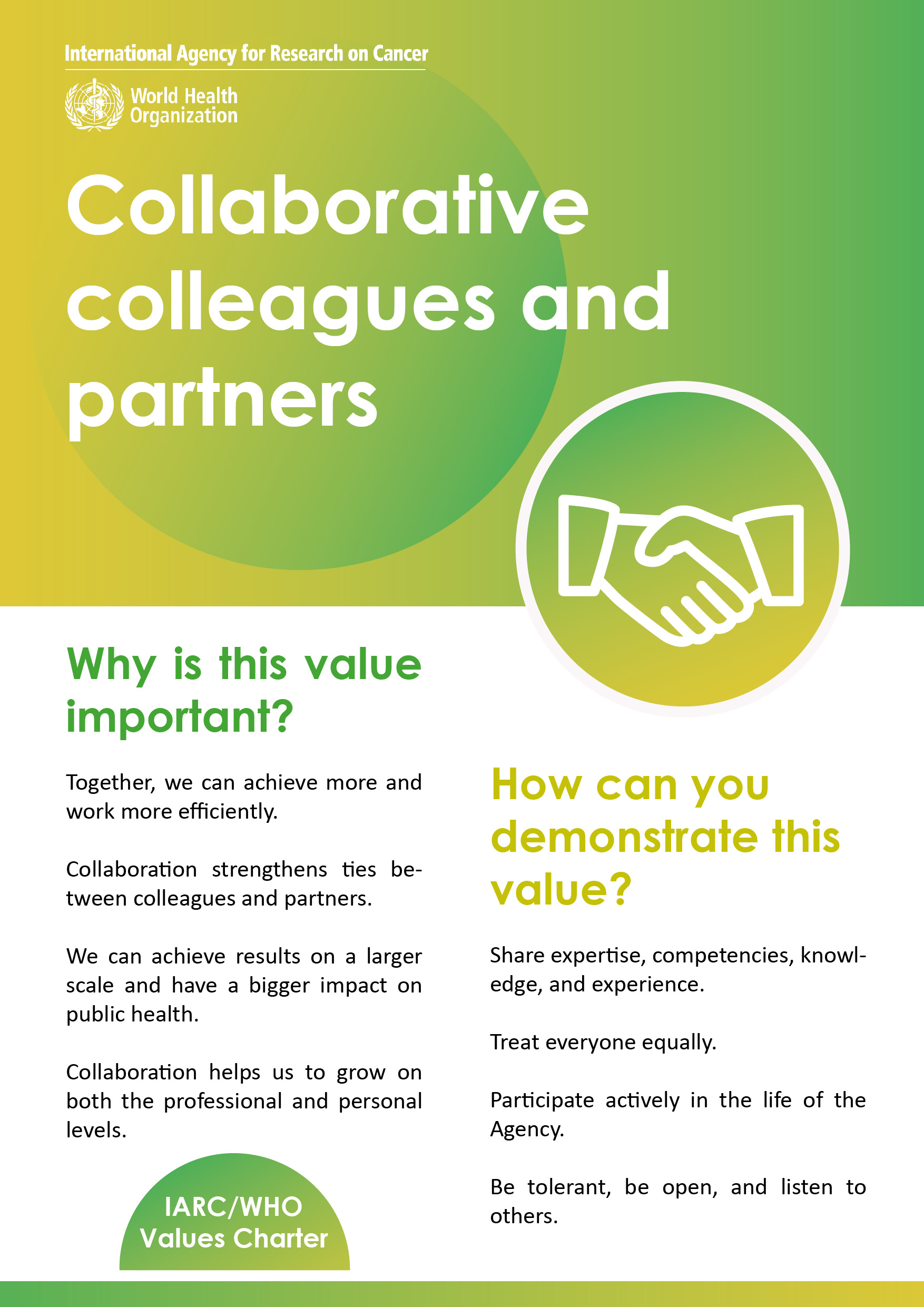
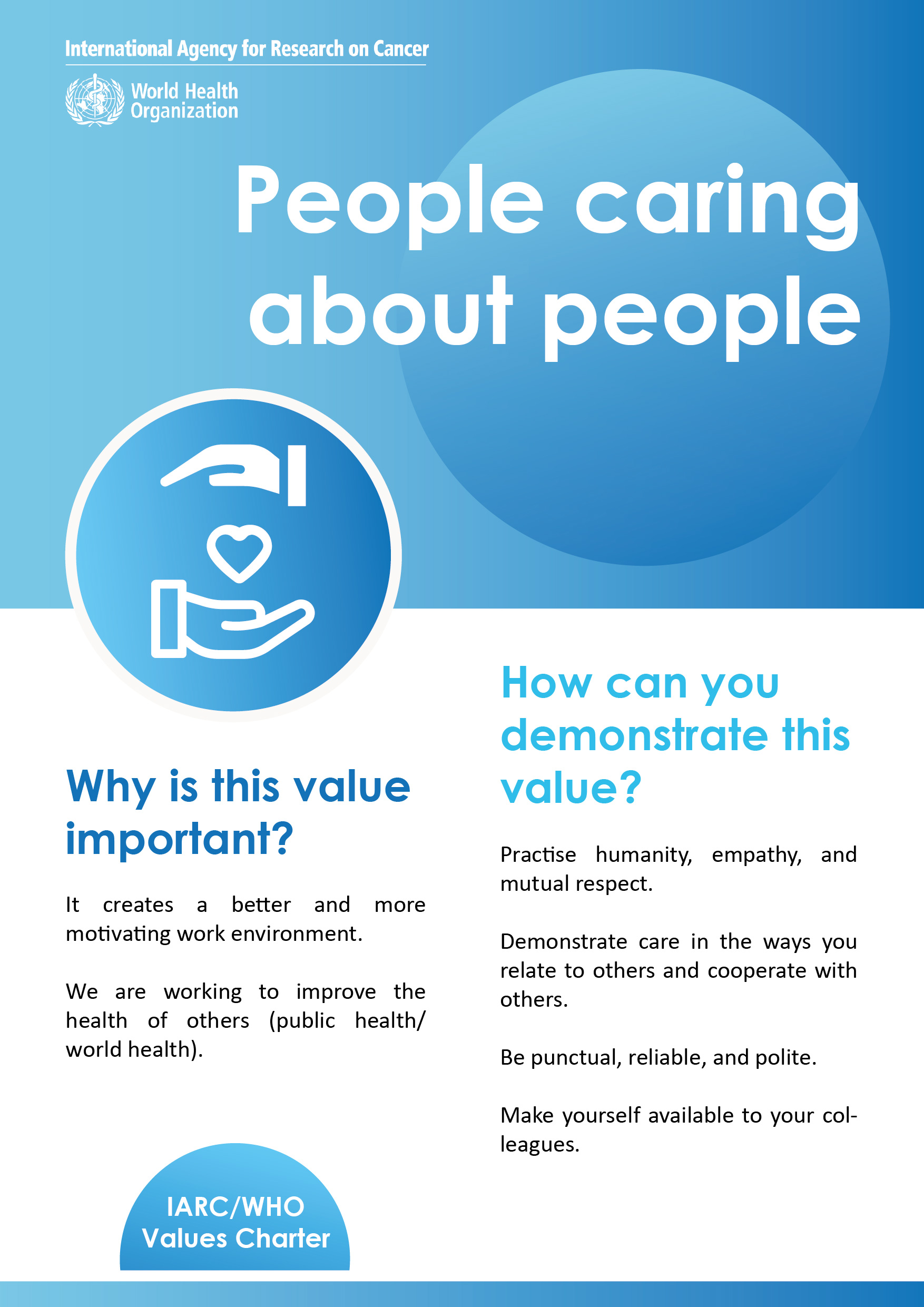
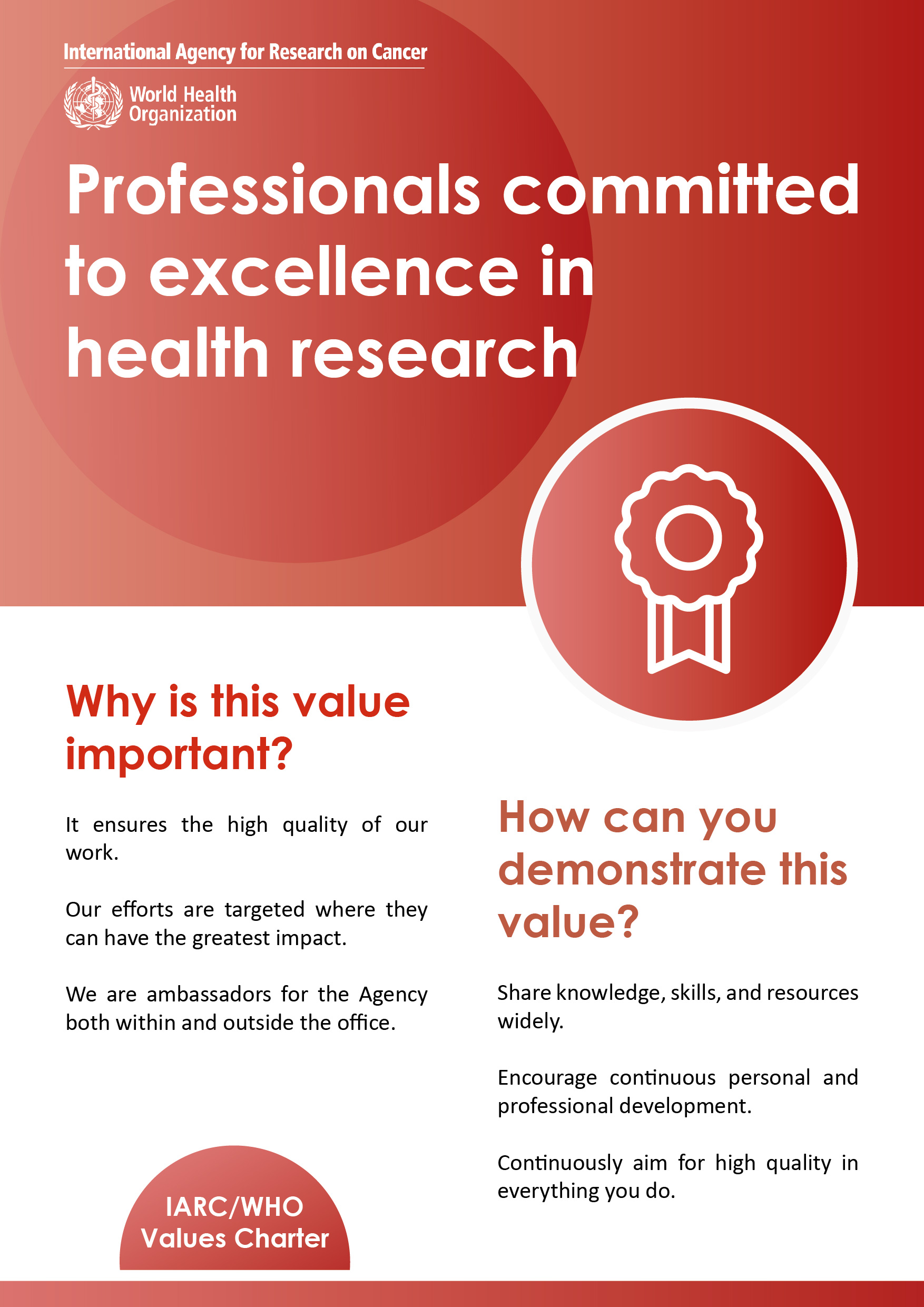
IARC/WHO values inform the outside world about the Agency’s culture and provide funders, collaborators, potential employees, public health systems, and the general public with a clear concept of the Agency’s identity. These values are:
IARC/WHO Professional Standards of Conduct
Demonstrating IARC/WHO values requires a clear description of the standards of conduct and guidance on how to respect them. The IARC/WHO Professional Standards of Conduct are the foundation of a culture of accountability and transparency.
Adhering to Ethical Principles and Conduct
- The International Civil Service Commission (ICSC) Standards of Conduct for the International Civil Service and the WHO Staff Regulations lay down the roles, obligations, and responsibilities expected of any international civil servant.
- The compiled policies on ethical principles and conduct of IARC/WHO staff describe the standards of ethical values and conduct that the Agency expects from all personnel, as well as those standards and rights that the personnel may expect to have recognized and respected by the Agency. (Where relevant, IARC aligns its professional standards of conduct with WHO-wide ethics policies, which are maintained on the WHO Ethics webpage as the authoritative and regularly updated reference.)
Practising Responsibility and Integrity in Research
- In light of IARC/WHO’s research mission and public health role, the IARC Ethics Committee (IEC) ensures that the Agency only supports research that respects the most rigorous ethical principles and standards. More broadly, the IEC ensures that IARC/WHO’s research is ethically appropriate and reflects the values of an institution that is part of WHO and of the broader United Nations family.
- The WHO Code of Conduct for Responsible Research provides standards of good practice to guide all personnel involved in research to act in alignment with the principles of integrity, accountability, independence/impartiality, respect, and professional commitment described in the compiled policies on ethical principles and conduct of IARC/WHO staff. Guidance on the internal procedures for managing any suspected wrongdoing in research is provided in the IARC Policy on Scientific Misconduct.
- Ensuring the adequate level of protection of personal data and privacy principles is of the utmost importance to IARC/WHO, in line with internationally recognized standards. To this effect, IARC/WHO complies with the Personal Data Protection and Privacy Principles for UN System Organizations, UN-HCLM 2018 (the “UN Principles”), and has implemented a specific IARC/WHO Data Protection Policy.
Recognizing and Avoiding Conflicts of Interest
The work of IARC/WHO on global health issues requires the assistance of external collaborators and entities. To be effective, the Agency’s work must be, actually and ostensibly, objective and free from any perceived undue external influence that would affect its integrity, independence, credibility, and reputation. Accordingly, IARC/WHO has implemented robust due-diligence and risk-assessment processes:
- Declarations of Interest for staff: Identified IARC/WHO staff members are required to disclose on an annual basis any interests that may conflict with their functions as international civil servant, and/or could be perceived as impeding their adherence to the principles of integrity, independence, and impartiality.
- Declaration of Interests for IARC/WHO Experts: To protect the integrity of IARC/WHO as well as to protect the integrity of individual experts the Organization collaborates with, the Agency requires that experts serving in an advisory role disclose any circumstances that could give rise to actual or ostensible conflict of interest.
- Framework of Engagement with Non-State Actors (FENSA): All partnerships and collaborations with non-state actors, namely nongovernmental organizations, private sector entities, philanthropic foundations, and academic institutions, are evaluated by IARC/WHO against a set of rules established by the Sixty-Ninth World Health Assembly.
Committing to a Respectful Workplace
- Equity, Diversity, and Inclusion: IARC/WHO is committed to ensuring equity, diversity, dignity, worth, inclusion, and equality of all persons. Diversity is what makes the Agency stronger, more innovative, and more creative.
- Preventing and Addressing Abusive Conduct: IARC/WHO is committed to providing a safe and respectful work environment free from discrimination, abuse of authority, and harassment (collectively referred to as “abusive conduct”).
- Preventing and Addressing Retaliation: IARC/WHO is committed to protecting whistleblowers against retaliation and to addressing wrongdoing by instituting remedies and taking disciplinary action as appropriate.
- Preventing and Addressing Sexual Misconduct: IARC/WHO has zero tolerance towards sexual misconduct and inaction against it. “Sexual misconduct” includes, but is not limited to, sexual exploitation, sexual abuse, sexual harassment, and any form of sexual violence. IARC/WHO is committed to preventing any form of sexual misconduct in its workplaces and operations.
Guidance and Consultation
In instances of alleged abusive conduct including, but not limited to, harassment or retaliation, or issues of research integrity, all IARC/WHO personnel are strongly encouraged to speak up and seek advice as early as possible as per the above-mentioned policies.
IARC/WHO personnel have a duty to report wrongdoing, and in doing so will be protected as per the Policy on Preventing and Addressing Retaliation.
- Several informal and formal resolution mechanisms are established to provide clear and action-oriented advice in a secure and confidential environment for all IARC/WHO personnel.
- The WHO Integrity Hotline provides a safe and independent mechanism to report, confidentially and/or anonymously, any concerns about issues involving IARC/WHO.